The Iron Krten Bench Series
Volume II — Raspberry Pi Pico LED Projects
Dial Clocks, LED Cube, Dot Matrix Display, and HEXBUS Game
You can never have enough clocks — and you can never have enough LEDs either.
In this hands-on guide, you build a family of light-emitting projects using the Raspberry Pi Pico, bare-metal C, and a deep regard for the WS2812. Every chapter follows the development story — what was designed, why, and why not.
Source code, schematics, PCB layouts, gerbers — all included.
Chapter overview:
Dial Clocks
Three concentric bands of 38 mm LED filament lights make a working dial clock — two builds, 156 LEDs then 228 — plus a 19-LED WS2812 moon-phase complication. Laid out with km; synchronized to GPS; “boustrophedon” included at no extra charge.
The Cube
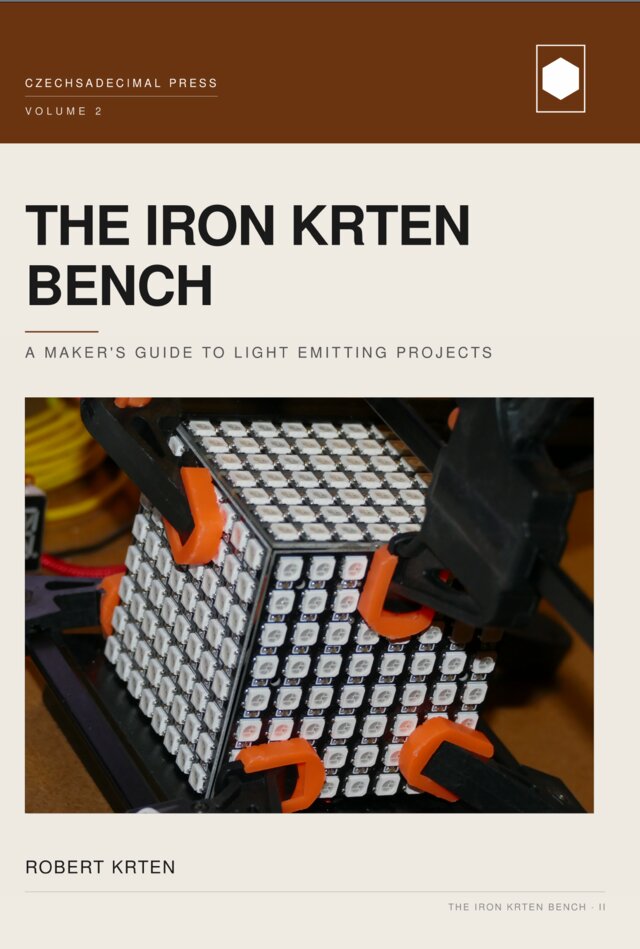
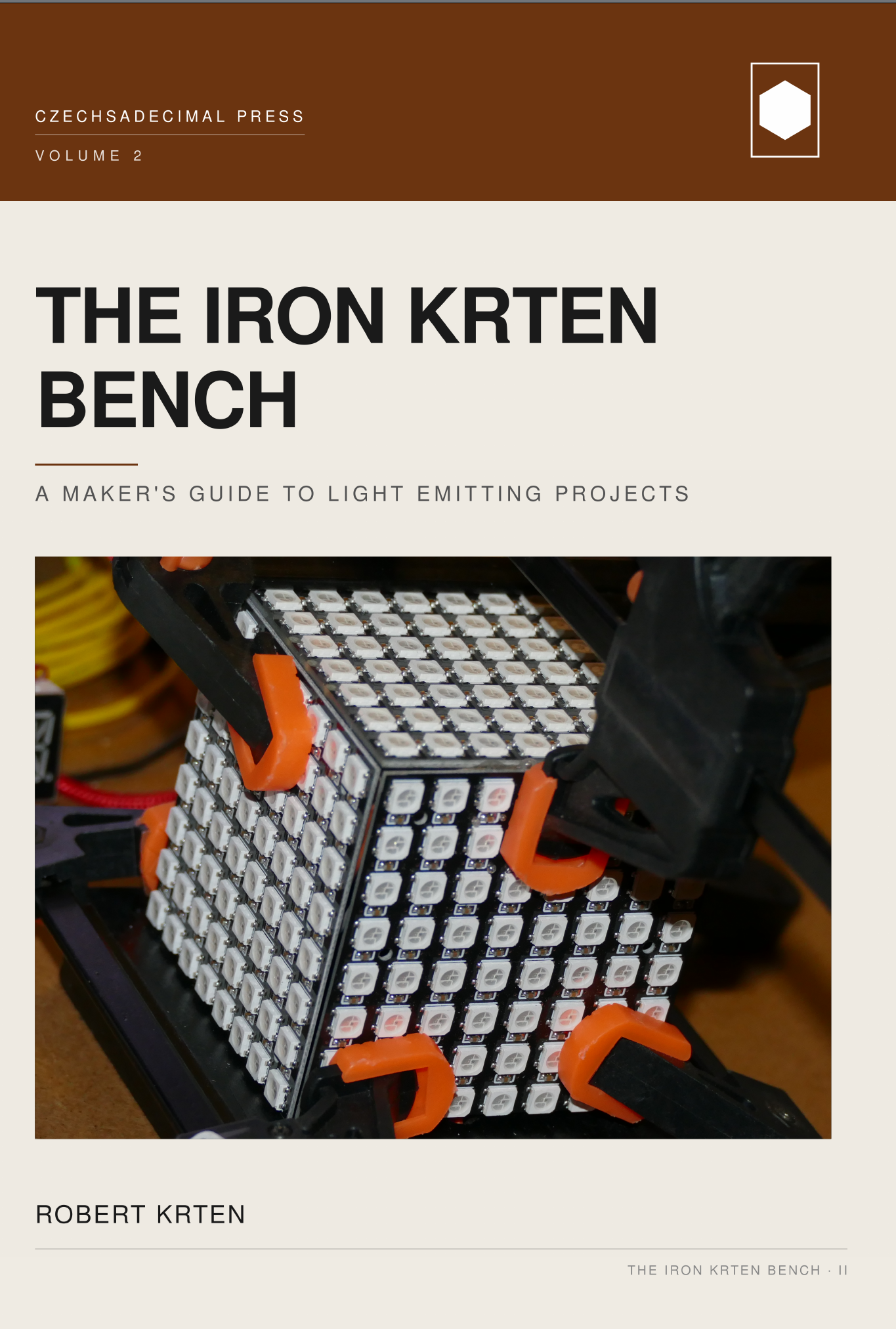
Five 8×8 WS2812 panels for fifteen dollars. Or, if you're feeling brave, five 16×16 panels for sixty dollars and seventy-six amps of potential current draw (!) Power budgeting, frame rate, topology, brightness curves, and the patterns that earn all five faces their photons.
The Dot Matrix Display
A dot-matrix digit reborn as a nixie tube — outsourced SMD assembly, four-layer boards, and individual LED modules deep-pour resin-cast into acrylic tubing.
The PABX Display Board
Reverse-engineering a 1980s display board from a 6809-based PABX — 8 seven-segment and 16 status LEDs — into an exact, drop-in-compatible replacement, decades later.
HEXBUS Game
A hex-grid logic-puzzle console built from the author's own HEXBUS puzzle book — 37 WS2812 LEDs on a 100 mm board, navigated with two rotary encoders. Just 15 unique boards — rotated, mirrored, and negated — yield millions of game starts.
Tools, Libraries, and the WS2812 in depth
km, a C++ “KiCad Move” utility that parses KiCad's S-expression PCB format and automates circular component layout, plus a GPS time-sync library and a WS2812 deep dive.