The HEXBUS Hex Grid Solving Game
There's a common game out there that deals with a "binary puzzle grid" (known as Binairo or Takuzu). You have a square grid with an even number of rows and columns, and each cell can have a zero or a one in it. The puzzle is played by filling the cell elements that are empty. There are simple rules:
- you cannot have more than two of the same value in a row or column immediately follow each other
- the number of zeros and ones has to be the same across each row and each column
- all rows are unique, and all columns are unique.
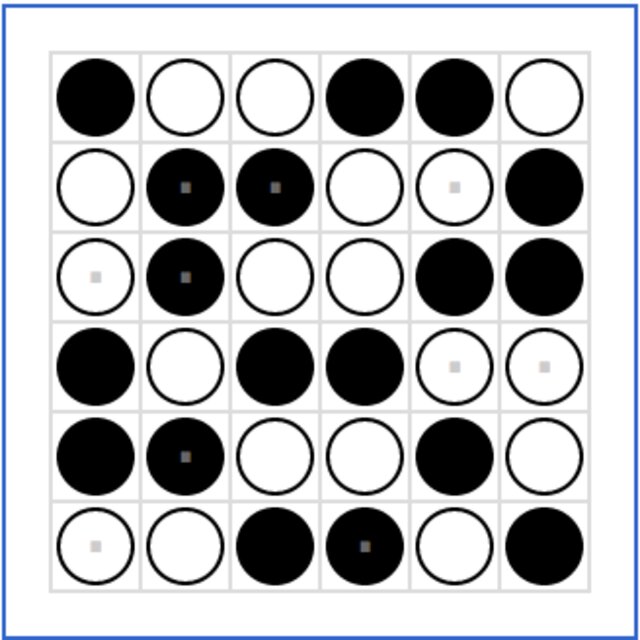
I wrote about this in my Generating Binary Puzzles article. There, I focused on optimization techniques.
What is HEXBUS
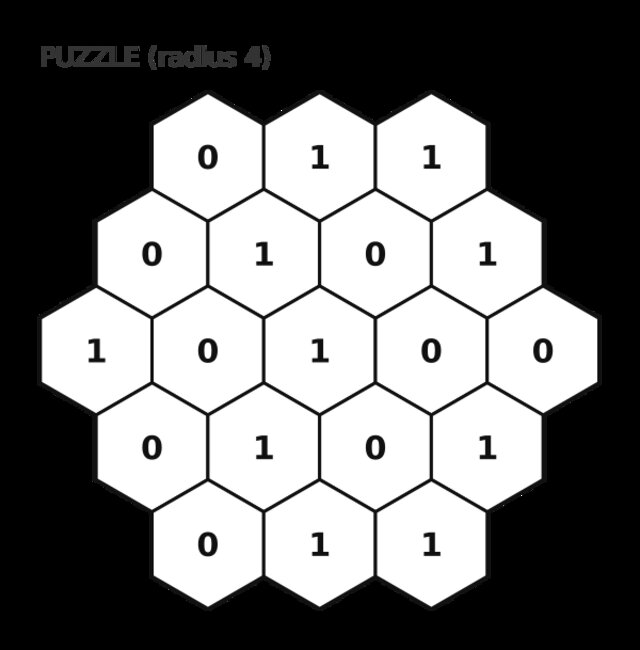
I have a new and interesting twist on the binairo puzzle — I call it "hexbus", and it differs in that there are three axes at play, arranged in a hexagon:
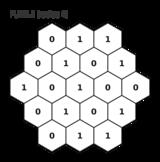
You'll notice a few things that are different than the binary puzzle:
- there are three axes!
- there's a row axis (the 011 on the first row, then 0101 on the second, then 10100 on the third, and so on)
- there's a "top left to bottom right" axis (starting at the leftmost element, we have 100, 0011, 01101, and so on)
- and there's a "top right to bottom left" axis (starting at the rightmost element, we have 011, 1001, 10110, and so on)
Since this is a hexagonal puzzle, the number of elements in each axis varies; in the above there are 3, 4, and 5 element axes.
This means we need to modify the rule of "the number of zeros and ones has to be the same across each row and each column" rule to be "the number of zeros and ones cannot differ by more than one in each row and each column"
So, the top-most row, 011, satisfies that rule becase there is one zero and two ones — the counts don't differ by more than one. On axes with an even number of cells, the rule implicitly means that the counts must match — you can't have them differ by only one. Look at the second row: 0101, there are two zeros and two ones.
Try it!
You can try an alpha version of HEXBUS — The Game here